September 2026 | In this issue: the enshittification of creative work, fiction for women (and men), and why both of these impact how we perceive publishing
Musing of the Month
This piece is stuffed with hyperlinks so please click away at anything underlined (except this example).
I’ve been thinking a lot about the feminization of the publishing industry. Whether we’re focusing on the outspoken demand for more novels for men and young boys or critiquing the rise of ‘smut’ across the romance market, the messaging is clear: women dominate the industry, just not in ways that are deemed appropriately feminine or professionally valued.
How utterly predictable.
And yet, we’re debating the reason why nonfiction sales are precariously dropping (apart from the rise of religious trade and gift/craft/hobby titles). Elif Shafak pointedly summarizes it: “Male readers, above a certain age, usually of a certain background, upbringing, with all good intentions, they come and say to me, ‘You know, so much is happening in the world today, so I read more about finance and technology and politics, history, you know, the important things. I don’t have time for fiction,’ they say, and then apologetically, they are, they say [sic], ‘But my wife reads fiction,’ or ‘My girlfriend reads fiction.’ And I feel really, really sad when I hear this. I think inside the novel there is politics, there is philosophy, there’s psychology, but more importantly there’s emotional intelligence.” (Full video here.)
Fun fact: the only day in which men outnumber women across bookstores is Christmas Eve. (This is, in fact, a favorite factoid of mine picked up from Michael Castleman’s The Untold Story of Books.)
I’m a firm subscriber to John McWhorter’s argument that teenage girls in particular determine linguistic trends and developments. This feels very aligned, both in theory and in practice, with the reading and book-buying habits that Shafak and Castleman speak to.
And while I’m still musing on the intricacies between these two factoids, these two perspectives on how men and women consume books, how they consider and craft stories, I think it’s important to also consider how feminized the work of publishing has become in the public image.
More than a decade on, I still see jaws drop when I share that starting pay was, on average, $36,000.00 when I first applied for industry jobs in New York City. Aspiring authors are surprised (and devastated) to read that advances rarely earn out, that livelihoods are almost never built on the backs of royalty checks. Editors and publicists, sales managers and production managers across Big 5 are still by-and-large advocating for unionization. Which is why a recent New York Times Magazine piece casually including “typesetter, book editor” among jobs that were (to steal Doctorow’s word) enshittified at the time that women became the primary labor market for those roles reads as particularly enlightening for those of us who have had to justify the value of our professions in an increasingly tech-driven economy. Noam Scheiber, who wrote the piece, even references a male typesetter telling an author, “It’s a girl’s job now.”
Now, these two roles are included by Scheiber to exemplify why 85% of new jobs have gone to women during this calendar year, a precedent for tech-jobs becoming increasingly unappealing to men seeking employment, but these two distinctly capital-P Publishing jobs are included nonetheless.
I recognize I’m biased when discussing women working in publishing—of course I am—but I’m also privileged to say that I love my job and I’m good at my job. (Good is a sterile word, a nothing word, as one of my talented represented authors repeatedly tells me, but it’s the word I feel most comfortable claiming.) But according to the AALA membership survey, I’m among the 83.2% of literary agents who identify as cis female and the 75% of literary agents who depend on secondary income streams. I fully recognize that being able to toss my hat into the ring as an agent, to build my list, is a privilege many want but do not have the means to pursue right now. I didn’t, prior to this year, but that’s another dive altogether.
There’s some good to news to share: Bloomberg Business reported just this past month (August 2026) that Romantasy as a consumer market is nearing $1 billion, naturally earning the attention of private equity. Do I like the idea that having Wall Street’s eye—a masculine-gendered sector, to be sure—is what will legitimize women’s reading and writing? No, I can’t say that I do. But will I reject the recognition that the writers, publishers, and readers have earned? Not in the least!
As for the increasingly outlandish scenarios that capture women’s readerships…well, we’ve already seen the six-figure acquisitions of previously self-published monster romance series, including Morning Glory Milking Farm which I can’t not mention (it’s journalistic due diligence) when discussing monster romances. I do not anticipate this bubble bursting anytime soon, not when sales depend on women readers. And who knows women readers better than women writers and publishers? Clearly there’s a proofpoint, to the extent that this othered MMC trend is even capturing the silver screen. (If you haven’t seen the trailer for Wicker yet…may I recommend you give it a watch to at least be ‘in the know’ ahead of awards season?)
Now to ensure that women who work to bring these stories to life are professionally valued and respected…

…other reads to sink into…
🔗 In Trump’s Economy, Job Gains Go to Women. That’s Not an Entirely Good Thing. The New York Times, Gift Link
The inspiration for this month’s musing.
🔗 Where Have All the Literary Men Gone?, Dan Sinykin’s Substack, Link
I’m a longtime fan of Sinykin’s sharp coverage of industry history, but this particular piece captured a spot on this list from the second sentence: “As publishing’s cultural status and financial prospects have declined, men…have left, and women have taken control of the industry.”
🔗 The Steamy, Magical and Now Very Lucrative Romantasy Business, Bloomberg Business, Link
No matter how much crap is thrown at Romantasy titles, no matter how much cited ‘dragon fatigue’ lives among agents and editors, the readers are ravenous…and private equity is taking note. I highly recommend reading this before you roll your eyes at the large Sarah J. Maas displays sure to takeover your local bookstores for the coming months.
📕 The Baby on the Fire Escape: Creativity, Motherhood, and the Mind-Baby Problem, Julie Phillips, Link to Bookshop.org
📘 A recent TBR addition: The Problem with Work: Feminism, Marxism, Antiwork Politics, and Postwork Imaginaries, Kathi Weeks, Link to Bookshop.org
Client Celebrations
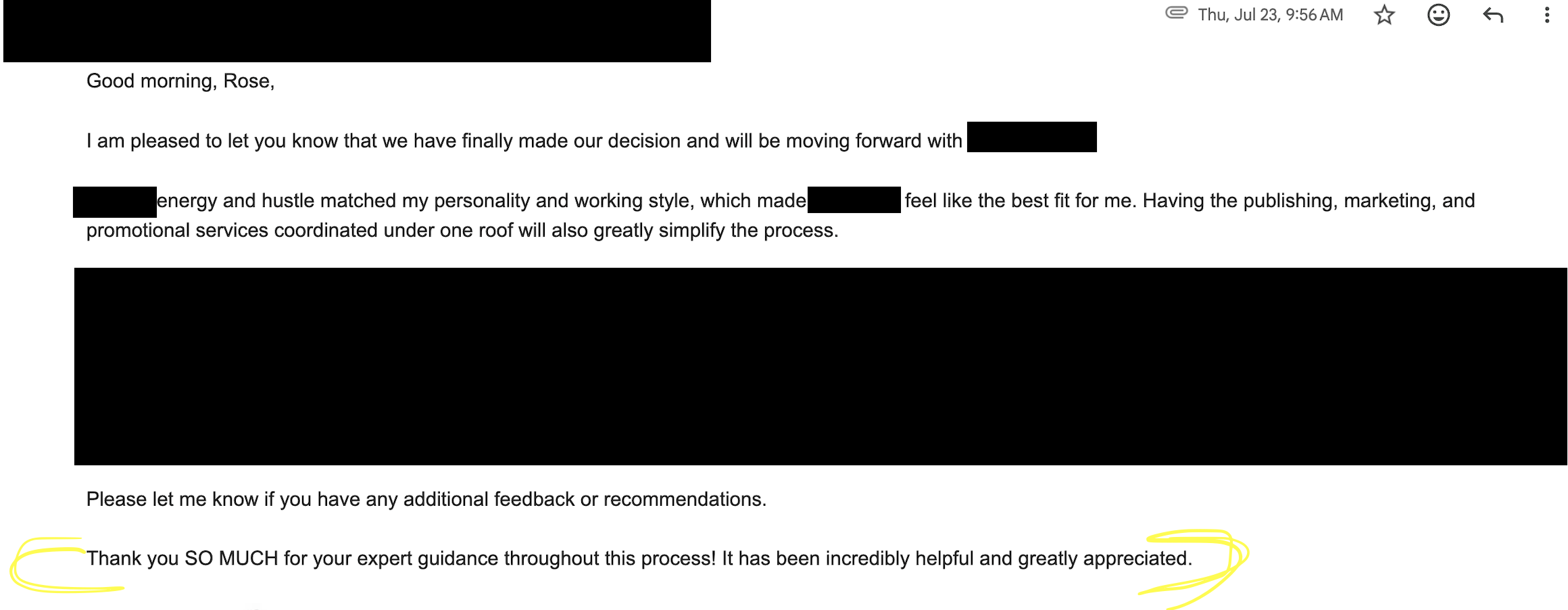
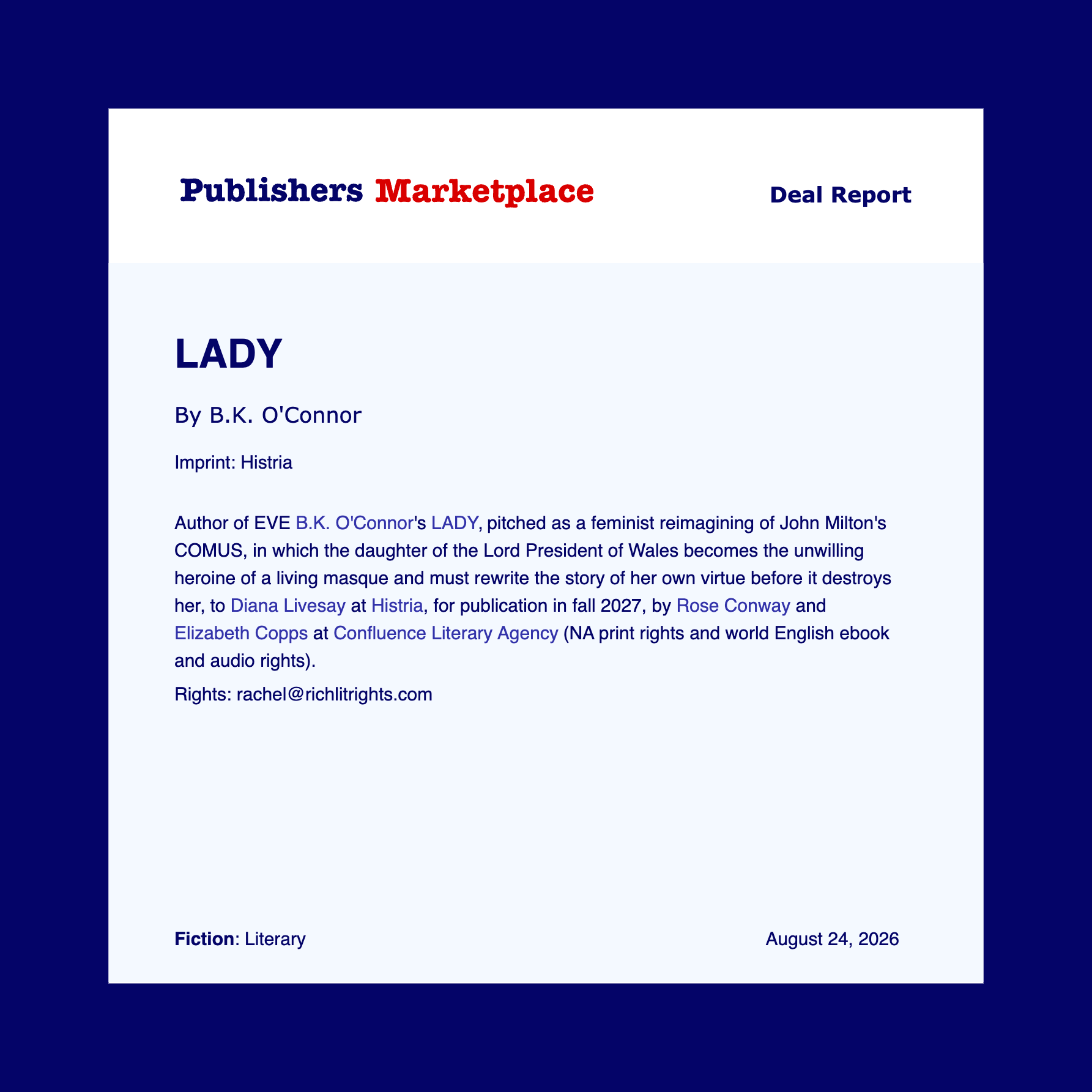
I’m here for the highs and the lows…but August had a lot of highs. Here is a gallery of wins from both my Foreword Lit and Confluence Literary Agency work.
Psst..You can tell them apart because the Foreword Lit ones are redacted.


Re-introducing The Foreword 60
This 60-minute individualized strategy call focuses on: your publishing goals, your overall progress to date, and your truest path to achieving them…all while debunking those pesky publishing myths along the way. After the call, you’ll receive an original, multi-page strategy document built for your book and your book alone. (Usually around 15 pages.) Limited spots per month.
This is a $300.00 investment transferrable to any larger Submission Toolkit or 3-month retainer contract.
Query Updates
I am now open to queries for what is most likely the last time this calendar year. Why?I’m focusing on editing and selling agented clients work through to January 2027. And while I love reading new queries, I’m also not in a space to take anyone new new on.
Exception to every rule: I’ll be attending MWA’s Brains to Bookshelf Conference October 10-11th, taking pitches on Sunday the 11th. Learn more here.
Free Resource!
QUIZ: Which Publishing Pathway Best Fits Your Author Profile?
It's not only about the content of your manuscript.
In fact, one of the biggest misconceptions I see from first-time authors struggle with--and one of the most debilitating barriers to enjoying your publishing experience--is the belief that there's a one-size-fits-all way to publish. It's how authors end up feel confused, bamboozled, or worse, disappointed by their publishing outcomes.
Thinking about what you need as an author throughout the process is the best way to break through that mental wall.
And all it takes is answering these 3 quick questions.